

Kenya is facing a growing fiscal dilemma: an unsustainable public wage bill that continues to outpace revenue growth and development priorities. Despite a number of reform efforts, including hiring moratoriums, job assessments, and salary standardisation, public sector compensation still places a significant burden on national and local budgets. The current pay bill violates the Public Finance Management Act (2012) and surpasses the globally recommended threshold of 35% (World Bank, 2023) by more than 45% of total government revenue.
Excessive wage spending has impeded social services and vital development projects, which has hampered economic growth and compromised the standard of public service delivery. It is becoming more and more clear that the core cause of Kenya’s pay bill crisis is structural inefficiency rather than simple overstaffing or inflation.
The solution lies changing the public servants’ pay structure from one that is based on tenure and grades to one that is performance oriented. A practical and long-lasting strategy to accomplish this goal is provided by productivity-based performance management, or PBPM.
The Wage Problem Behind the Numbers
The problem with Kenya’s wage bill concerns both its amount and its makeup. Instead of being compensated for measurable contributions to institutional efficacy or citizen outcomes, most public employees are paid according to job classification, tenure, or centrally negotiated scales.
Attempts to control the wage bill through comprehensive hiring freezes, salary rationalisation, and headcount audits have been short-lived and ineffective. Why? They fail to address the core problem, which is a pay structure that rewards attendance over performance.
The following factors make the inefficiencies worse:
- Performance management system implementation that is inconsistent
- Lack of clear productivity indicators
- Insufficient links between incentives and evaluations
- Pressures from outside unions and politics
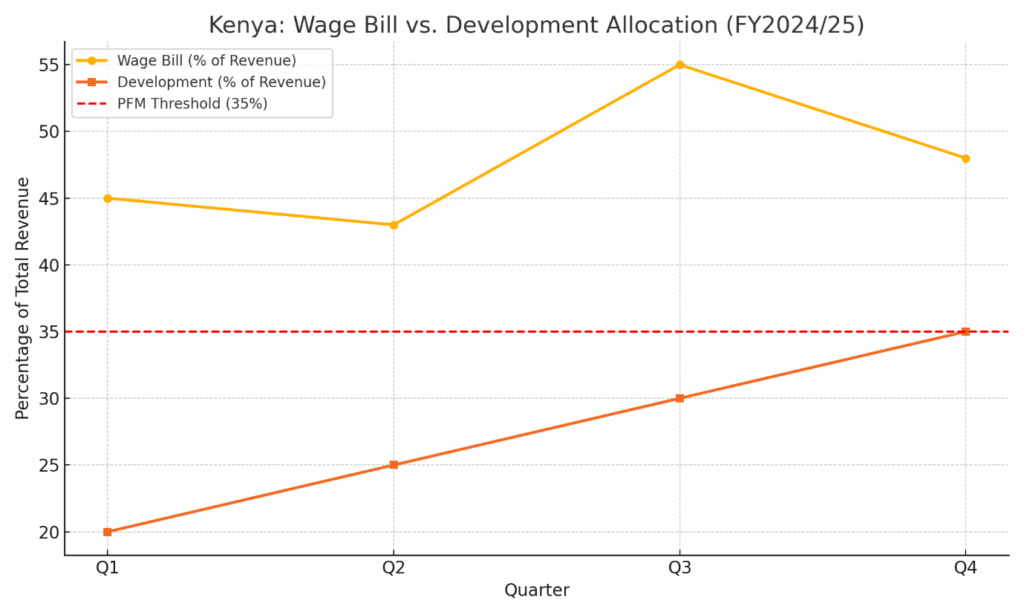
Figure 1: Kenya’s quarterly wage bill compared to development spending as a percentage of total revenue (FY2024/25).
Source: OCOB Reports 2023, 2024, 2025
Understanding Productivity -Based Performance Management (PBPM)
Pay-for-performance management (PBPM) is a method that businesses and institutions can use to link compensation and advancement opportunities to measurable outcomes. In contrast to more conventional input-based models, PBPM promotes accountability, creativity, and output by directly tying compensation to performance.
The core ideas of PBPM include:
- Clearly defined productivity metrics linked to institutional guidelines
- Performance reviews that are objective and transparent
- Linking incentives and pay increases to performance outcomes
- Changes to the institution’s performance culture
This methodology is supported by evidence from around the world. Productivity-based pay improves output and reduces agency problems (2000). According to Leaver et al. (2021) and the OECD (2024), public sector performance-based systems improve service quality, fiscal oversight, and institutional efficacy.
Kenya’s Missed Opportunities and the Case for Reform
Initiatives for performance-based compensation have been put into place in Kenya, but the results have been insignificant. Initiated in the 2000s, performance contracting guaranteed results and accountability. However, the initiative is largely symbolic in the absence of integration into payment systems or thorough monitoring.
Kenya’s public sector performance frameworks are characterised by fragmentation, insufficient data systems, and limited integration with compensation structures, according to Bii, Kwasira, and Iravo (2022). Reduced morale, higher payrolls, and lower returns on labour investment are the results.
It is clear why significant wage reform has proven elusive when taking into account the difficulties posed by inflation, union pressure, and politically influenced hiring.
Why PBPM is the Answer?
PBPM is a financial necessity rather than just a management fad. Strategic implementation can address the core causes of Kenya’s wage bill crisis:
- Compensation Realignment to Value Creation – Workers are paid according to their productivity rather than their tenure or identity.
- Phantom capacity and inefficiency can be reduced by using performance analytics to find unnecessary jobs, which makes it possible to have a more focused and efficient workforce.
- Improved Service Delivery: Public employees are encouraged to deliver better, faster, and more responsive services through performance-based compensation.
- Accountability and Fiscal Discipline – Linking pay to results creates a results-oriented culture and budget predictability.
The Role of Counties and the National Government
According to recent data, county governments are particularly vulnerable to pressure from wage bills. Many counties spent up to 69.5% of their total budget on staff in the first quarter of FY2024–2025, which is much more than what is considered sustainable. While compliance with wage-to-expenditure ratios has been comparatively stable at the national level (around 30%), the PE-to-revenue ratio surpassed 43% in multiple quarters, indicating a growing fiscal concern.
It is clear that Kenya needs a wage bill strategy that works effectively at both levels of government, and PBPM offers a framework that is revolutionary, scalable, and quantifiable.
Recommendations/Making PBPM Work
The following steps are necessary to put PBPM into action in all of Kenya’s public service:
- The Salaries and Remuneration Commission (SRC) and the Public Service Commission (PSC), along with the National Treasury, should work together to create a PBPM Policy Framework.
- Bring together and digitise performance monitoring Link HRMIS and IFMIS so that payroll and performance can be monitored and aligned in real time.
- Strengthen the institution’s capacity -Teach HR staff, department heads, and performance managers about PBPM tools and methods.
- Pilot in Important Counties and Ministries – Start with industries that have a big impact, like healthcare, education, and finance, and then grow based on what you learn.
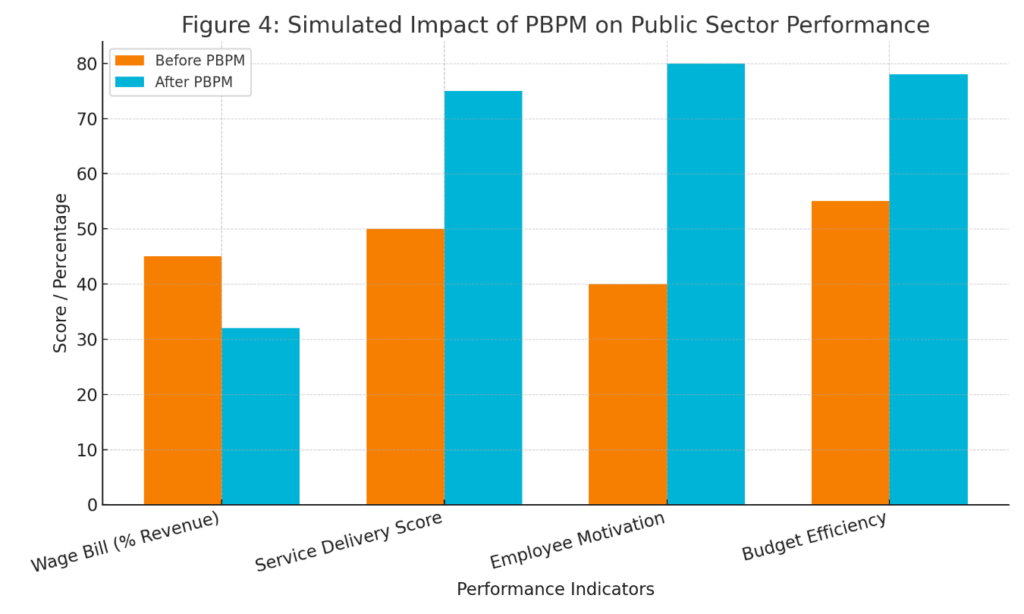
Source: Author’s projections based on public finance reform models
Conclusion
Kenya must decide whether to continue on the path of unsustainable pay increases or embrace a new public service mindset in which advancement is determined by productivity and compensation is determined by performance.
One tactic to escape the salary trap is Productivity-Based Performance Management. It ensures that results, not just attendance, are paid for with public funds. It restores budgetary discipline while enhancing service delivery. Additionally, it makes it easier for Kenya’s public sector to maintain its dedication to the populace.
The time to escape the wage trap is now.